How did you first get into tennis?
I was in high school and besides the swimming pool were the tennis courts and at that age, I was 17, 18 years old, I enjoyed meeting the girls, and of course all the girls were at the swimming pool so I went over and started learning how to play tennis so I could socialize with the girls.
What was your favorite part about tennis?
Uh, the running, the exercise and having good strokes. I was fortunate enough to have a good teacher who taught me good strokes, and to me those are the best parts. Also, winning a close tennis match tiebreaker, yep.
When did you start coaching?
Lets see, I graduated college in 1970, and it was two years later, so I started in 1972, in Charlotte, North Carolina.
So I’ve been teaching for, gosh, what’s that? 50? 54 years.
What’s your favorite part about coaching?
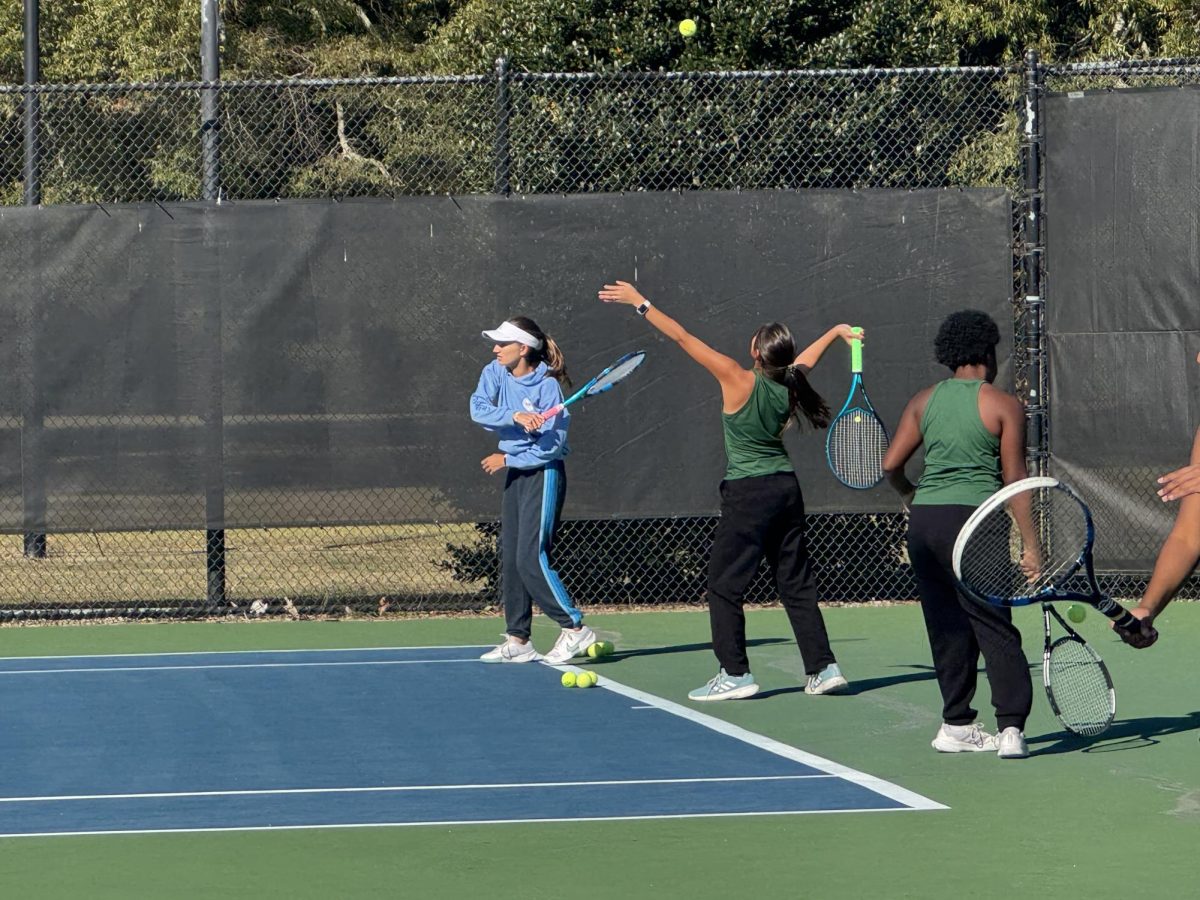
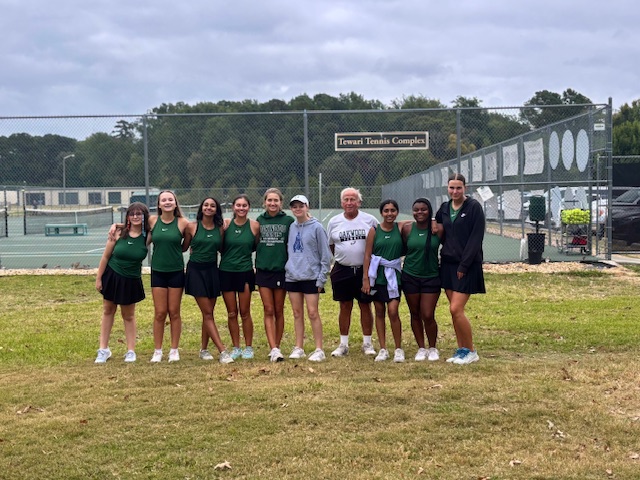
The kids here at Oakwood are a perfect example. Number one I enjoy watching the kids get better, ‘cause a lot of the times when I start with most of the kids they’ve never been taught. So they don’t have good strokes.
And what I normally do is this: In all private lessons, in your first lesson, I’ll tape you on video, and I’ll keep that, and then I’ll tape you about every 6 months.. And then, every 2 years, down the road, I’ll bring it out, like.. Here’s a perfect example. I had a girl in Charlotte, and I’d been teaching her for about 3 years or so.
I said, “Honey, I want to show you a video of a little girl.” And in the video she was terrible.
So I showed her the video, and she looked at it and said “Her strokes are terrible, she’s awful!” She looked at it again and I said, “Honey, that’s you.”
And she said, “That can’t be me! I was never that bad.”
And I said “Honey, that really is you.”
And that changed my life right there, because they don’t realize how bad they were until they see how much they’ve improved. Seeing my kids improve and seeing them seeing themselves improving is my favorite part about coaching.
And I can say that about almost everybody on Oakwood’s team, looking at their strokes. So much better than they were.
So, yeah, it’s the gratification of watching the kids get better. That’s what I really really enjoy. And the kids knowing that they’re getting better.
What other sports have you played?
In high school I played baseball and football. I was a baseball player. So I played baseball seven days a week from the time I was nine years old till I was 18. I was gonna be a professional baseball player.
And when I graduated from high school, I got drafted by the Chicago White Sox, but I didn’t make the majors. I played minor league, but didn’t quite make it to the majors.
So I played baseball, and then I was a co-captain of the football team, too, so I played, yeah, baseball and football.
What’s the worst sports injury you’ve had?
Gosh. I’ve had my shoulder replaced. I’ve had my knee replaced, I’ve had my ankle replaced. I had a bad dislocated ankle. So they had to go in and put six long screws in my foot, still there now, and that’s why I can’t run, this foot, I’ve barely got any movement now.
And that killed me, ‘cause when your strokes get good, the rest of the game is movement, getting in position, but I can’t run anymore. So then I couldn’t play anymore, which I hated. I was very competitive. I hate not being able to play competitions anymore. I love tournaments, I love competition.
Do you have a favorite player?
Rod Laver. When I was teaching, in Atlanta, two of my good friends were tennis pros at Hilton Head Island, of Palmetto Dunes, and I’d go down every weekend, just to get away from Charlotte, and so one day I drove down and they asked me, “Terry, we need you to play an exhibition match tomorrow morning.”
I said, “Okay, sure”, ’cause I went down every weekend and played with them. And I asked “Who’s the fourth?” They said, “Rod Laver.” I said, “Rod Laver?!” He said, “Yeah.”
And at that time, Rod Label was ranked number one in the world. He was like Alcaraz is now.
So here I am, a little nobody. I mean, I was a good national player, but now I’m playing tennis with Rod Laver! And so I played four or five exhibition matches with him. And also down there, I played an exhibition match with Stan Smith. I played one with Arthur Ashe. I used to play Stan Smith’s wife almost every weekend.
But yeah, so for Rod Laver, he came into town every so often, and they always got me to play exhibition matches with him. Also, I was married at one point, and he was actually the one who introduced me to my wife.
Any other tennis stories?
Here’s another story: I taught in Atlanta for 13 years, and in Atlanta ladies tennis is huge. The number one league in the entire world. And I taught them for 13 years, and then I moved to Dallas.
I got a call one day, and they said, “Terry, there’s a big tournament in Charlotte. We want you to come in and play in the tournament.” And I said, “Eh”, but then they said, “We want to invite a lot of your ex students to come watch you play.” ’cause I was still a good nationally ranked player. So I said, “Okay.”
So I came in and we started playing the tournament, and there was a big stadium there, and it was full of probably 200 women that I used to teach. And that was nice, they all wanted to come see me. I hadn’t seen most of them in years.
And so we were playing in the second set, it was the hottest day of the year. It was 96 degrees. And I went to my partner almost towards the end of the second set.
I said, “Dick, I quit sweating.”
And if you quit sweating, your body is overheating. It can’t cool itself.
So, he said that we needed to default.
I said, “Dick, I can’t not play. These ladies came all the way to see me.” I said, “I’ll tell you what I’m gonna do. We’ll play the third set. I’ll just stand here and cover the alley.
He said, “Stay here and cover the alley, I’ll take care of everything else.”
So we played the match and we finished, and we sat down and all these women are here and they’re hugging me and kissing me, talking and all that.
And all of a sudden, it’s like somebody walks up behind me and hits me in the back with a sledgehammer.
And I go, “AAAH!” And we were playing right in front of the courts, a lot of the games were still going on. And I mean, I had shouted real, real loud. And all the courts stopped.
A second later, it’s even worse. My legs, “AAAH!” In my chest, “AAAH!” In my arms, “AAAH!”
And I stood up, put one arm around one guy, the other arm around Dick, and I said, “Call 911. I’m in trouble. I’m in a lot of trouble.”
And bam, I was gone. They laid me down on the court. Luckily, there were two doctors playing on the first court, and they yelled out, “Keep his head elevated, keep his head elevated!” And they all come running up, and they start CPR, and they call 911. So the ambulance comes, and, you know, they give me CPR, and the doctor turns to the crowd and says, “No pulse, no heartbeat.” So they hit me again, did more CPR, they did that for another three, four minutes, and turned to the crowd again. “No pulse, no heartbeat.” and the ladies were screaming and hollering and crying.
So they hit me the third time, and then the doctor turned to the crowd and said, no pulse, no heartbeat, I’m sorry, we’ve lost him. And I was dead.
And one of the other doctors said, ”Hit him one more time.”
And they hit me that fourth time and my heart started back up.
And while I was on the other side, I heard a voice.
The voice said, “You’re being sent back to help others.”
And that voice was the man upstairs. And that’s why I was sent back, to help kids get better.
I mean, they pay me to teach here, but I would teach for nothing, for the kids, for y’all. That’s why the man upstairs sent me back.
True story. True story.
I thank him every day. to let me come back and work with y’all. And it makes me feel good when I see y’all getting better, and hopefully we’ll start winning championships and conferences and things like that. So yeah, I mean, this is me, this is what I do. I enjoy this. This is what I’m here for. This is what I’m here for.
Oh, and another thing, too. I called the doctors the next day to thank them for saving my life. And when I was talking to him, I said, “Doc, why did you pull my shorts down?”
He said, “Terry, how did you know we did that?”
I said, “Doc, I was there above you, hearing everything that went on.”
He said, “Well, you had to be, ’cause we never said anything to you about pulling your shorts down. But the reason for that is, your groin is the most sensitive area of your body to get a pulse. And that’s why we pulled your shorts down, to get a pulse. I know you must have heard it, otherwise you couldn’t be asking me this question.”
So I said, “Doc, I was there the whole time. I heard you, I heard the ladies crying, you know, I mean, I could see everything that was going on.”
I know it sounds like a made up story, but that’s the truth, that’s the truth.
I’m very thankful to be here.. Yep. But it’s tough getting old. God, it’s tough getting old. I used to be able to teach eight hours a day, I barely teach three now. But I’ve been having a good time doing it. I’ve been having a good time doing it.
How many students do you think you’ve taught over the years?
Oh, God, I don’t have any idea. I graduated in ’70. So every so many every year since 1972. I wouldn’t have any idea. I mean, thousands. Thousands and thousands.
But I always enjoy working with kids that are learning. That, that’s what I enjoy.
Oh, that reminds me of another story: One of the little girls when I was leaving one time, she came up to me, she gave me a big hug around the neck, and said “Coach Terry. I sure do love you.”
I said, “Well, honey, I love you, too. Why’d you say that?”
She said, “‘Cause you care about me, and I know you care about me.”
That made it worthwhile. That makes it worthwhile.